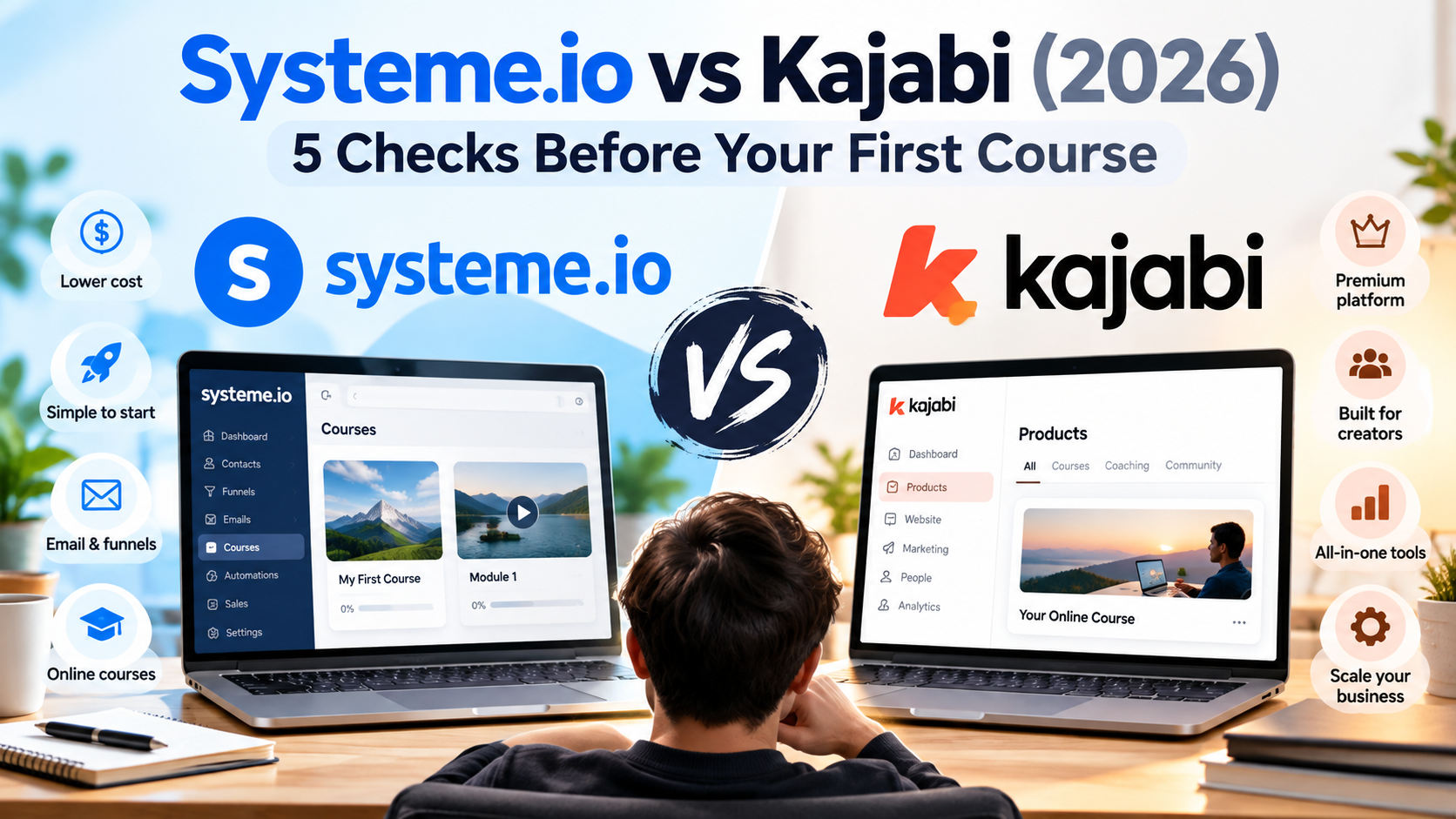
Choosing between Systeme.io vs Kajabi can feel harder than building the course itself.
Both platforms can host courses, collect payments, send emails, and build sales funnels. But they approach the job very differently.
Kajabi is a more premium platform built around running and scaling a knowledge business. Systeme.io focuses more heavily on simplicity, affordability, and getting an online business launched with fewer upfront costs.
If you are preparing to sell your first online course, you probably do not need a feature-by-feature comparison of everything either platform can do.
Ultimately, the right Systeme.io vs Kajabi choice depends on your budget, business stage, and how much infrastructure you need from day one.
Instead, check the five things that are most likely to affect your first launch.
This Systeme.io vs Kajabi comparison focuses on the five practical checks that matter most before launching your first online course.
Quick takeaway: Systeme.io is generally easier to test when you want to keep startup costs low. Kajabi becomes more attractive when you already know you want a more advanced course-business environment and are comfortable with the higher fixed cost.
Table of Contents
This article may contain affiliate links. If you purchase through one of these links, we may earn a commission at no additional cost to you.
1. Systeme.io vs Kajabi: compare the first launch cost
The biggest difference for a first-time course creator is often not the course builder.
It is the amount you have to spend before you know whether the course will sell.
Systeme.io offers a free plan. According to its current pricing information, the free plan can support one online course and up to 2,000 contacts, with no credit card required to get started. Systeme.io also states that it does not charge a platform transaction fee, although your payment processor can still charge its own fees. Systeme.io pricing
Kajabi takes a different approach.
Its Basic plan is currently listed at $179 per month when billed monthly, or $143 per month when billed annually. It includes up to five products, 2,500 contacts, a website, a community, email marketing, and other business tools. Kajabi pricing and plan features
That does not automatically make Kajabi expensive.
If your course already produces revenue, consolidating several tools into one platform can make sense.
But for a creator launching a course before validating demand, the fixed monthly cost matters.
Ask yourself:
Do I need advanced infrastructure now, or do I first need proof that someone will buy the course?
If you are still testing an idea, keeping the fixed cost close to zero gives you more room to experiment.
Related: [See our full Systeme.io pricing breakdown]
Affiliate link. Opens in a new tab.
2. Walk through the student journey
When comparing Systeme.io vs Kajabi, the student experience is just as important as the creator dashboard.
Course creators naturally focus on what the admin dashboard looks like.
Students care about something else:
Can I log in, find the lesson, and continue learning without getting confused?
Before choosing either platform, test the student experience from beginning to end.
Systeme.io currently supports course features such as content dripping, module locking, and student progress tracking. Systeme.io course features
For a bounded example, our two-lesson Systeme.io free course test records one manual enrollment and saved 100% progress in the owner dashboard. An October 7, 2026 follow-up directly checked the same learner’s re-login, access to both text lessons, and saved completion after reload. The linked walkthrough explains this single-account text-course test’s limits. We have not tested Kajabi under the same conditions.
Kajabi is designed specifically around digital products, courses, coaching, communities, and related knowledge-business products, with its course infrastructure integrated into the broader platform. Kajabi pricing and plan features
Run through these five checks:
| Test | What you are checking |
|---|---|
| First login | Is account access obvious? |
| Mobile access | Can students comfortably consume lessons on a phone? |
| Release schedule | Can lessons appear when you want them to? |
| Access problem | Can you quickly help a student who cannot log in? |
| Refund | What happens to course access after a refund? |
The best platform is not necessarily the one with the most course features.
It is the one that gives your students the experience your course actually requires.
For a simple self-paced course, Systeme.io may already cover what you need.
If the course itself is the center of a larger premium knowledge business, Kajabi gives you a broader environment around that product.
3. Separate subscription costs from payment fees
The cost difference in Systeme.io vs Kajabi becomes clearer when you separate subscription fees from payment-processing fees.
This is where platform comparisons often become misleading.
There are two different costs:
Platform subscription cost
and
payment-processing cost
Systeme.io states that its plans carry 0% platform transaction fees. You can still pay normal charges to a payment provider such as Stripe or PayPal. Systeme.io course features
Kajabi also markets its current plans without revenue sharing and lists its pricing separately from payment-processing costs. Kajabi pricing and plan features
So the key comparison is not simply:
“Which platform takes less from each sale?”
Instead calculate:
Monthly platform cost + payment processing + any additional tools you still need
For example, a cheaper course platform can become more expensive if you also need separate email marketing, funnels, automation, and affiliate software.
Likewise, an all-in-one platform can be difficult to justify if you only need a basic course and a checkout page.
That is why the right comparison depends on the business you are actually running.
4. Check the work around the course
Another important part of the Systeme.io vs Kajabi decision is how much work each platform handles outside the course itself.
Selling a course involves much more than uploading lessons.
You may also need:
- Landing pages
- Email sequences
- Checkout pages
- Upsells
- Automations
- Affiliate management
- A website
- Customer support workflows
Both Systeme.io and Kajabi cover many of these functions.
Systeme.io includes tools for sales funnels, email marketing, websites, affiliate management, automation, courses, and communities. Systeme.io pricing
Kajabi similarly combines courses with websites, email marketing, funnels, communities, payments, and broader business-management functionality. Kajabi pricing and plan features
The difference is less about whether a checkbox exists and more about how much depth you need from it.
For a solo creator trying to launch quickly, simplicity can be an advantage.
You may not benefit from a more advanced system if you only use 20% of it.
On the other hand, if you already have a growing audience, multiple offers, automations, team members, and a community, a more sophisticated platform may reduce the need to rebuild later.
Related: [Read our Systeme.io review for solopreneurs]
5. Plan your exit before building everything
This check is easy to ignore.
Before you build your entire course business inside one platform, ask:
What happens if I want to leave?
Migration can involve much more than moving video files.
You may need to move:
- Student accounts
- Email contacts
- Landing pages
- Automations
- Checkout pages
- Domains
- Affiliate links
- Course structures
- Subscription customers
The more deeply your business depends on one platform, the more expensive switching can become.
That does not mean you should avoid an all-in-one system.
It means you should treat migration risk as part of the original buying decision.
If you are experimenting with your first offer, a lightweight setup can reduce that risk.
If you already know the business model works, deeper integration may be worth the tradeoff.
Systeme.io vs Kajabi: which one fits your first course?
For a first course, the choice usually comes down to your current stage.
Choose Systeme.io when your main priorities are:
- Keeping fixed costs low
- Testing a course idea before committing heavily
- Running your funnel, email, checkout, and course from one affordable platform
- Starting with a free plan
- Keeping the setup relatively simple
Consider Kajabi when you are more focused on:
- Building a larger knowledge-business ecosystem
- Managing several digital products
- Using more advanced business infrastructure
- Running a premium course or community business
- Paying more upfront for a more mature platform environment
The important point is that more features do not automatically mean a better first-course platform.
Choose the platform that matches the business you have today rather than the business you imagine having several years from now.
Affiliate link. Opens in a new tab.
Frequently asked questions
Is Systeme.io cheaper than Kajabi?
Yes in terms of entry price. Systeme.io currently offers a free plan, while Kajabi’s Basic plan starts at $179 per month when billed monthly. Annual Kajabi billing reduces the effective monthly price. Kajabi pricing and plan features
Can Systeme.io host an online course?
Yes. Systeme.io supports online courses as well as features such as drip scheduling, module locking, and progress tracking. Systeme.io course features
Does Systeme.io charge transaction fees?
Systeme.io currently states that it charges 0% platform transaction fees. Payment providers such as Stripe or PayPal can still charge their own processing fees. Systeme.io course features
Is Kajabi only a course platform?
No. Kajabi combines courses with websites, email marketing, funnels, communities, payments, coaching, and other tools intended for knowledge businesses. Kajabi pricing and plan features
Which platform is better for a first course?
That depends mainly on your required features, budget, and business stage. Systeme.io lets you test a course with much lower fixed costs, while Kajabi provides a broader premium environment for an established or more complex knowledge business.
Our verdict
For a solo entrepreneur launching a first course, Systeme.io’s free entry point makes it possible to validate the idea before taking on a significant software bill.
Kajabi offers a deeper platform and can make more sense once the course business itself justifies the additional fixed cost.
The practical decision is therefore not simply Systeme.io vs Kajabi.
It is:
How much platform do you actually need before making your first sale?
If you want to start small, test the offer, and upgrade only after the business earns revenue, Systeme.io provides a straightforward route.
Related: [See how Systeme.io’s funnel builder works]