Setup, confirmation email and the observed subscriber transition
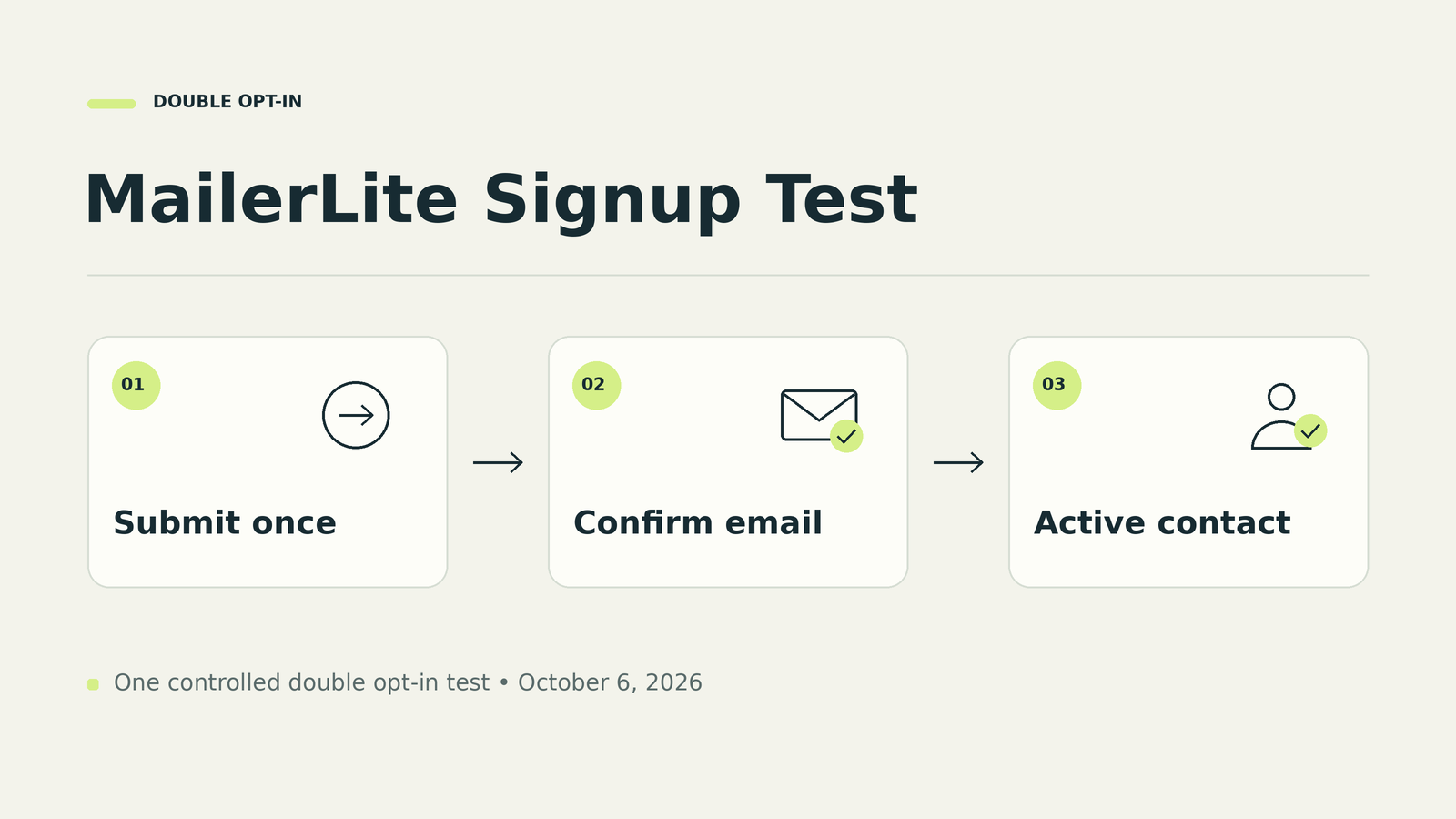
Our MailerLite signup test completed a controlled double opt-in flow on October 6, 2026. One authorized test address was submitted once, received a confirmation email and appeared as Unconfirmed before the link was clicked. After confirmation, MailerLite showed Active and recorded activation by confirming signup.
This MailerLite signup test covers the setup, the DNS complication and the observed signup-to-confirmation result. Evidence level: Tested for this bounded flow. The record combines owner-operated checks, screenshots and a public-page inspection. It is one owner-controlled test, not evidence of real-world lead acquisition or a deliverability rate.
Table of Contents
MailerLite signup test setup
On the morning of October 6, the account displayed Free with 13 days of a premium trial remaining. That timing matters: features visible during this session cannot all be described as permanently available on Free.
Recorded configuration: A landing page named GSL MailerLite Test, the group GSL MailerLite Test Leads, an email-only field and double opt-in switched on. The page copy described an invitation-only test.
Saved page settings: SEO title “GSL Email Signup Test”; description “Invitation-only email signup test for Growth Stack Lab.”; search-engine indexing set to No; Google Analytics and Meta pixel fields empty.
The public page returned HTTP 200 and contained invitation-only copy, an email-only form, Subscribe and the exact GSL privacy-policy link. Its robots directive was noindex, nofollow. The owner confirmed empty Page/Header custom-code areas and empty Google Analytics/Meta fields. “Disable tracking for all visitors” was saved as Yes. These checks do not establish the absence of cookies or network requests; signup records still included IP/location data. Noindex does not restrict access to a public URL.
What the current Free limits mean here
MailerLite’s pricing page, checked October 6, lists 250 active subscribers, 2,500 monthly emails, three active automations, five automation steps and one landing page on Free. Our small test does not need to approach these limits. The trial remains a separate qualification until the intended configuration is checked after it ends.
Source 2 — What the premium trial includes
Domain authentication and the existing mail setup
The domain already supported email forwarding and an EasyWP-related sending configuration. This made a generic “add the SPF record” instruction insufficient. The existing forwarding service’s locked SPF setup had to be understood before changing DNS.
During troubleshooting, an initial suggestion involving aliases did not resolve the actual SPF-editing problem. The proposed approach was questioned and corrected. The practical lesson is to give support the current record and the exact editing restriction, then check that the proposed change preserves the services the domain already uses.
After the owner approved the specific changes, the manual setup added the account-provided DKIM CNAME and domain-verification TXT record. The existing root SPF record was edited to consolidate the forwarding, MailerLite and EasyWP requirements. This article deliberately omits the account-specific verification value and the final SPF string: they should not be copied into someone else’s DNS.
Evidence record for authentication
Expected: MailerLite accepts the required records while the domain’s existing forwarding remains usable.
Actual: The provider UI displayed Authenticated on October 6 at 10:17 JST. The sender address was also shown as verified. The owner subsequently confirmed that an incoming message to the domain mailbox still forwarded to Gmail.
Fix applied: Owner-approved manual DNS changes, including editing the existing SPF record rather than treating the new sender as an isolated setup.
These observations establish a provider-reported authentication result and one working forwarding check. The separate confirmation-email test described below supplies the observed receipt evidence. We did not complete an independent DNS lookup, validate the SPF lookup count or prove that every resolver saw the same records. No deliverability percentage can be inferred from this result.
DNS update — October 7, 2026: At 11:15 JST, Google and Cloudflare public DNS resolvers returned two root SPF records. After owner approval, we removed only the standalone EasyWP SPF record at 11:23 JST. At 11:24 JST, both resolvers returned one SPF record: the existing combined record covering email forwarding, MailerLite and EasyWP. The other DNS records and email forwarding settings were preserved, and the public MX records matched the pre-change baseline. We have not yet repeated send-and-receive tests or audited the full SPF DNS-lookup count. This confirms the duplicate-record correction; it does not establish whether delivery was affected or confirm post-change email delivery.
How to use this finding on another domain
First identify where authoritative DNS is managed and which services already send mail for the domain. Keep the existing values available before making an approved change. Use the names and values generated for your own account, and ask the DNS provider how a managed or locked record should be updated. Recheck both the email platform’s status and any existing mail service affected by the change.
MailerLite’s manual-authentication guide identifies DKIM, SPF and domain-verification records and provides a Check DNS Records action. It also notes that updates may take time. Repeatedly changing records without isolating the mismatch makes the result harder to interpret.
Source 3 — MailerLite domain authentication
Double opt in and the page editing restriction
Double opt-in was on and the controlled test completed. The confirmation email, the pre-click Unconfirmed status and the post-click Active status were observed separately. The standard confirmation page still used newsletter wording despite the test’s narrower purpose.
Evidence record for the thank you page
Expected: The confirmation thank-you page can be reviewed and its wording adjusted for the invitation-only test.
Actual: Selecting Edit content for that page returned a 403 screen with “Not available on free plan.” The standard wording “You’ve signed up for the newsletter” remained.
Fix status: No verified editing workaround. The restriction remains part of this account’s observed result.
The thank-you-page result should be kept separate from the confirmation-email editor. MailerLite’s official double opt-in guide explicitly says confirmation-email editing is available only on paid plans. Our screenshot records an additional, specific page-editing restriction encountered in this session; it does not establish that every customization route is unavailable.
Source 4 — MailerLite double opt in guide
Keep the invitation and data use consistent
The invitation-only signup test is for checking signup and email confirmation. GSL’s privacy policy, updated October 6, describes MailerLite’s role, the test records and the review/deletion approach after 30 days. It says the test does not enrol participants in a newsletter or course. The public page’s privacy link was verified against that published policy before submission.
We do not treat the platform’s default newsletter wording as permission to send campaigns or course messages. The test purpose, invitation, page copy and permitted use of the resulting record must remain aligned. The owner-controlled test proceeded with that limitation understood. The wording should be reviewed before inviting other participants.
MailerLite signup test: questions answered
What succeeded in this signup test
One authorized test address received the double opt-in email, and confirmation changed the observed contact state from Unconfirmed to Active in the intended group. No message-header analysis or independent inbox-folder evidence was captured, so this result does not establish delivery speed or guaranteed inbox placement.
Was the initial signup button problem fixed
The owner got past an initial account-signup button problem. Its cause and the action that resolved it were not established, so we cannot offer a reproducible fix.
MailerLite signup test protocol
Scope: one authorized test address, one submission, double opt-in confirmation and contact-state verification. All observation times below are JST on October 6, 2026. They describe when evidence was seen, not exact mail-server delivery times.
1 Verify the final page without submitting
Expected: A public email-only form with invitation-only copy, the intended privacy link and reviewed tracking settings.
Actual: The public URL returned HTTP 200; its form, privacy link and noindex, nofollow directive were verified. The tracking-disable setting was saved as Yes at 20:13. The owner removed the unrelated template footer, verified at 20:27, while retaining MailerLite branding.
Fix: Template footer removed before the submission. Page/Header custom-code areas and GA/Meta fields were confirmed empty. No claim of zero data collection follows from these settings.
2 Submit once, then inspect the email and contact
Expected: One submission produces a confirmation request; the contact remains unconfirmed until the confirmation action.
Actual: At 20:28 the owner submitted once and saw “Thank you! You’ll hear from us soon.” By 20:30, screenshots showed the email from Growth Stack Lab to the approved test address with “Confirm your email.” At 20:32 the contact was Unconfirmed and its Subscribed field displayed a dash.
Fix: None required for this observed step. No repeat submission was made. The evidence does not establish exact delivery latency or inbox placement. A pre-test search returned zero matches, but a global all-status uniqueness check was not independently verified.
3 Confirm and reconcile the contact record
Expected: The confirmation link completes the signup and updates the intended contact and group.
Actual: After the owner clicked, the mobile confirmation page at 20:34 showed “Thank you! You’ve signed up for the newsletter.” The dashboard showed Active. Contact details then showed GSL MailerLite Test Leads and activity recording activation by confirming signup for GSL MailerLite Test, plus addition to the group.
Fix: None required for the observed activation. The default newsletter wording remained; its editing restriction is documented separately.
What the timestamps and records mean
The contact details displayed a Subscribed/opt-in date of 2026-10-06 11:32:58. The interface timezone was not confirmed, so this value is preserved as displayed and is not converted into an asserted event time. The observation chronology above uses JST; it should not be substituted for message headers or platform event-time documentation.
The contact record included technical signup data such as IP/location. Disabling visitor analytics therefore did not mean that MailerLite stored no signup metadata. The test address, IP values and identifying screenshots are excluded from this article.
4 Close the test within its stated purpose
Expected: Keep the record within the approved test purpose and review its retention 30 days after completion. Any later campaign, welcome message, unsubscribe or PDF-delivery test needs its own scope.
Actual: The bounded confirmation flow completed October 6. The retention-review date is November 5, 2026 (JST). No campaign, welcome automation, unsubscribe or PDF-delivery test was performed as part of this flow. No automatic deletion or irreversible purge was configured.
Next action: Review the test record on November 5 under the stated policy and obtain any required deletion approval. Recheck after trial expiry before claiming permanent Free-plan compatibility.
What this MailerLite signup test shows so far
This MailerLite signup test demonstrates the bounded path from one authorized form submission through a received confirmation email to an observed Active contact in the intended group. Existing domain services and plan-specific editing controls still shaped the setup. A complete marketing funnel and general deliverability performance remain outside this evidence.
If you are choosing a platform rather than checking one signup path, our existing comparison covers that broader decision. This record adds account-specific setup and double opt-in evidence to that broader comparison.